
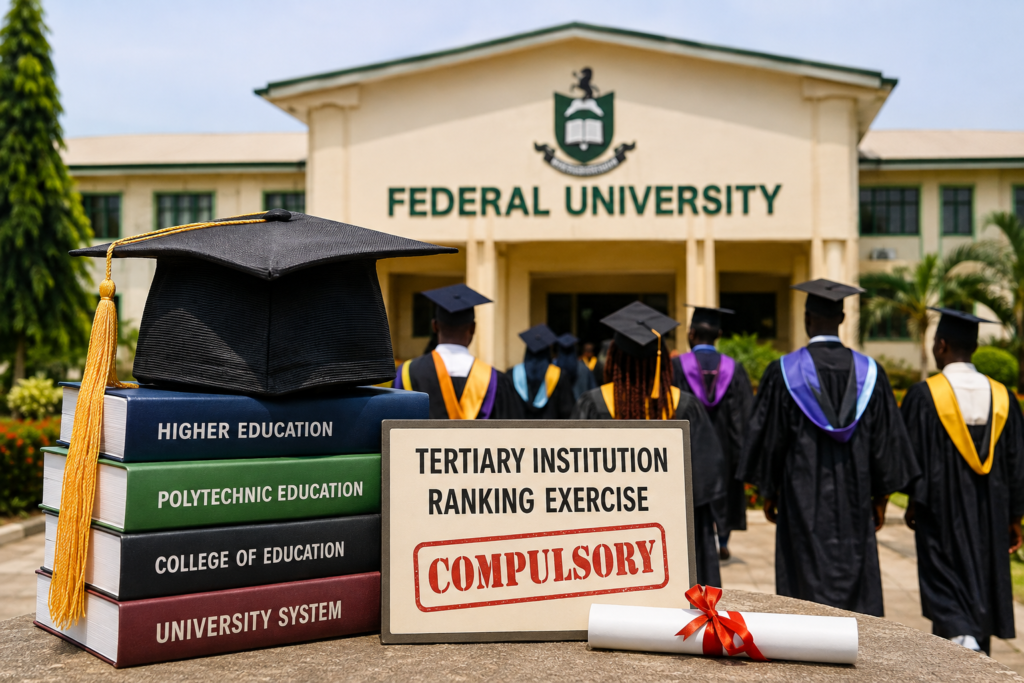
The Federal Government has directed all universities, polytechnics and colleges of education to participate in Nigeria’s national tertiary education ranking exercise, making the assessment compulsory across the sector.
The Minister of Education, Dr Tunji Alausa, announced the development on Tuesday in Abuja during a meeting with the Nigerian Universities Ranking Advisory Committee (NURAC). The committee has now been broadened and renamed the Nigerian Tertiary Education Ranking Advisory Committee.
Alausa explained that the expanded framework is intended to raise quality, accountability, institutional performance and global competitiveness within Nigeria’s tertiary education system.
He noted that the ranking would give institutions measurable standards through which they can evaluate their performance, identify areas where they are falling short and monitor improvements over time. It is also expected to encourage healthy competition among institutions.
With the revised arrangement, universities, polytechnics and colleges of education will operate under a common national ranking framework. The Federal Government is expected to finance the exercise through the Tertiary Education Trust Fund (TETFund).
According to Alausa, the 2026/2027 ranking exercise for universities is scheduled to begin in September, while the advisory committee will determine when polytechnics and colleges of education will be incorporated into the exercise.
He further stated that the government would establish formal guidelines for the ranking system and communicate directly with vice-chancellors and heads of other tertiary institutions to make it clear that participation is mandatory.
The minister linked the initiative to President Bola Tinubu’s education reforms under the Renewed Hope Agenda, being implemented through the Nigeria Education Sector Renewal Initiative.
He assured that the Federal Ministry of Education would provide the required policy guidance, financial support and capacity-building assistance to ensure the ranking system delivers credible, sustainable and meaningful results.
Alausa added that the ministry would partner with the committee to provide in-service training and institutional capacity-building programmes across tertiary institutions, with the broader objective of helping more Nigerian institutions achieve international recognition.
The Minister of State for Education, Professor Suwaiba Ahmad, described the development as a major step towards improving accountability and quality across Nigeria’s tertiary education system.
Ahmad emphasised that competition among institutions could encourage them to critically assess their performance, identify existing gaps and continually work towards improving the standard of education they offer.
She also called for the ranking system to encompass public and private tertiary institutions, saying this would create a mechanism for setting and sustaining minimum standards across the sector.
According to her, the exercise would help institutions gain a clearer understanding of their strengths and weaknesses, while encouraging measurable improvements as the country’s tertiary education landscape continues to expand.
Speaking on the development, Emeritus Professor Peter Okebukola, chairman of the ranking advisory committee and former Executive Secretary of the National Universities Commission, said the committee’s engagement with Alausa followed a memorandum congratulating the Tinubu administration on the increasing number of Nigerian universities achieving global recognition.
Okebukola disclosed that the committee had also appealed for greater investment in university education to sustain the progress and accelerate the sector’s development.
He explained that the minister went further than the committee’s initial recommendation by expanding NURAC’s responsibilities to cover polytechnics and colleges of education.
As a result of the expanded mandate, NURAC has been converted into the Nigerian Tertiary Education Ranking Advisory Committee, giving it responsibility for a wider section of Nigeria’s tertiary education system.
Okebukola expressed optimism that continued investment, improved institutional capacity and the new national ranking framework would help more Nigerian institutions advance in international rankings.
He added that the framework could strengthen the ability of Nigerian institutions to compete confidently with leading higher education institutions around the world.
The new policy comes at a time when Nigerian tertiary institutions are under increasing pressure to improve their positions in global rankings, which assess areas such as research output, academic reputation, citations, international outlook and institutional resources.
Although more Nigerian universities are beginning to appear in international rankings, the sector continues to contend with challenges including insufficient funding, limited research capacity, inadequate infrastructure, staffing constraints and difficulties competing with better-funded institutions abroad.
By bringing polytechnics and colleges of education into the national ranking system, the Federal Government is broadening performance assessment beyond universities and creating a more coordinated approach to monitoring the quality and competitiveness of tertiary institutions nationwide.
The decision to make participation compulsory also shifts the exercise from a voluntary system to one in which tertiary institutions will be required to submit relevant data and assess their performance against nationally established benchmarks.
NASTV AFRICA
Manifesting Africa’s Greatness