
Nigeria is intensifying efforts to develop its domestic artificial intelligence capabilities and digital infrastructure as the Federal Government works towards its $1 trillion economic ambition. Policymakers are urging the country to move beyond reliance on imported technology and focus on creating and exporting homegrown digital solutions.
The Secretary to the Government of the Federation, Senator Dr George Akume, said Nigeria must go beyond providing basic connectivity and instead build strong indigenous innovation and digital sovereignty if the country is to realise its economic goals.
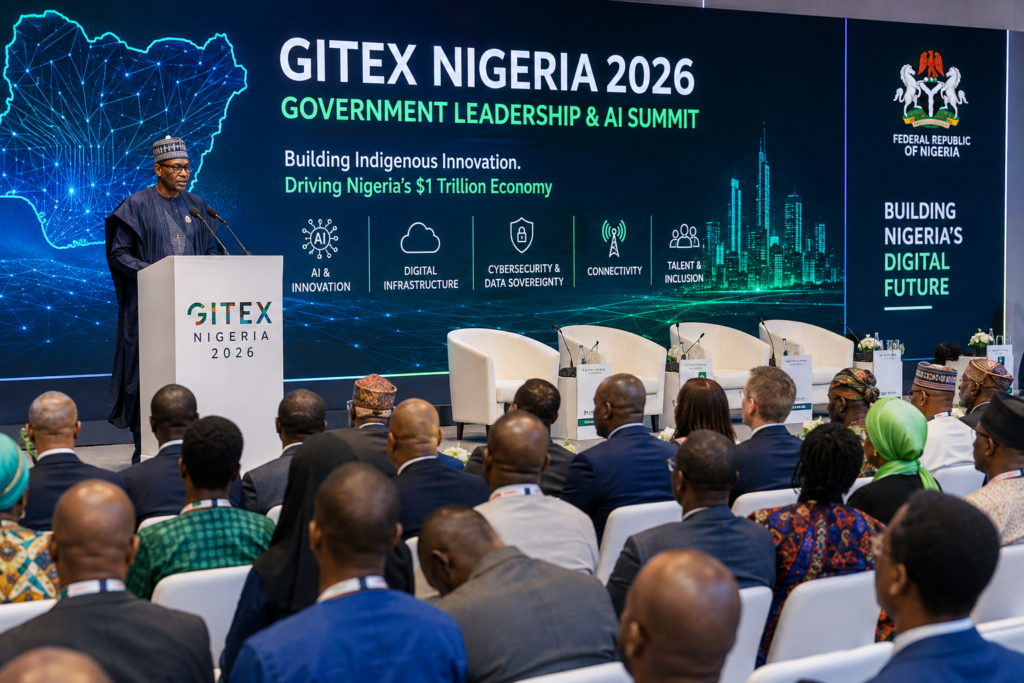
Akume made the remarks on Monday while declaring open GITEX NIGERIA 2026 in Abuja, where government representatives, technology leaders, investors and other stakeholders in the digital economy gathered for the Government Leadership & AI Summit.
He said the administration of President Bola Tinubu, through the Renewed Hope Agenda, was pursuing an ambitious path towards a $1 trillion economy.
“Under the vision of His Excellency President Bola Tinubu and the Renewed Hope Agenda, Nigeria is boldly driving toward a $1tn economy,” Akume said. He added that achieving meaningful economic transformation would require the country to move beyond basic connectivity and establish genuine indigenous innovation and digital sovereignty.
According to the SGF, GITEX NIGERIA offers an important avenue for the public and private sectors to coordinate their efforts. He identified domestic talent, sovereign digital infrastructure and inclusive artificial intelligence systems as key areas where Nigeria can maximise its opportunities.
Akume stressed that Nigeria must transition from simply using foreign technologies to becoming a producer of homegrown talent, sovereign infrastructure and inclusive AI solutions developed to address the country’s needs and compete internationally.
The Director General of the National Information Technology Development Agency (NITDA), Kashifu Abdullahi, said Nigeria was already laying some of the groundwork for digital sovereignty through investments in technical skills, connectivity, cloud infrastructure and regulatory development.
Abdullahi explained that genuine digital sovereignty requires the country to possess the capabilities, infrastructure and intelligence needed to power its future rather than depending heavily on external systems.
He highlighted programmes such as Digital Literacy for All, the 3 Million Technical Talent programme and Project BRIDGE, saying the initiatives are helping to expand Nigeria’s pool of technology professionals while strengthening digital infrastructure.
Beyond talent and connectivity, Abdullahi said the government was developing the necessary policy, cloud and regulatory frameworks to facilitate local data hosting and ensure responsible deployment of artificial intelligence.
He said GITEX NIGERIA was positioning the country to play a more influential role in the global technology ecosystem rather than simply participating in it.
The drive to build domestic AI capacity comes as governments across Africa seek greater control over the infrastructure and data supporting the continent’s rapidly expanding digital economy.
At the summit, Lagos State Governor Babajide Sanwo-Olu described Africa’s dependence on computing infrastructure located overseas as both a challenge and a major investment opportunity.
Sanwo-Olu observed that much of the international investment interest in Nigeria had traditionally focused on consumer fintech, which he described as the dominant technology opportunity of the previous decade.
He argued that computing infrastructure should now receive greater investment attention, pointing out that Lagos has significant subsea cable capacity but does not have a comparable level of computing infrastructure to handle the growing volume of data and AI workloads generated across Africa.
According to the governor, a significant portion of Africa’s AI workloads is currently processed in Europe, creating challenges around latency, cost and data sovereignty, while simultaneously presenting an opportunity for Nigeria to attract investment in local computing infrastructure.
Sanwo-Olu also identified the digitisation of public services as another emerging opportunity for technology companies. Areas he cited include procurement, revenue collection, permitting, health records, transportation and land administration.
Held under the patronage of President Bola Tinubu, GITEX NIGERIA 2026 is taking place from August 31 to September 3 across Abuja and Lagos.
The Abuja opening attracted more than 500 leaders and investors from the public and private sectors for discussions covering digital infrastructure, artificial intelligence, cybersecurity, data sovereignty, connectivity and investment.
The Lagos leg of the event is scheduled for September 2 and 3, featuring the Tech Expo, Future Economy Conference and FDX by GITEX. Startups are expected to use the programme to engage with international investors and technology companies. More than 200 investors from 30 countries, collectively managing about $200 billion in assets, are expected to participate in the Lagos programme.
The Federal Government’s wider strategy is to leverage digital infrastructure, local talent and indigenous technology development not only to reduce Nigeria’s dependence on foreign technology but also to unlock new avenues for economic growth as the country pursues its $1 trillion economy target.
NASTV AFRICA
Manifesting Africa’s Greatness