
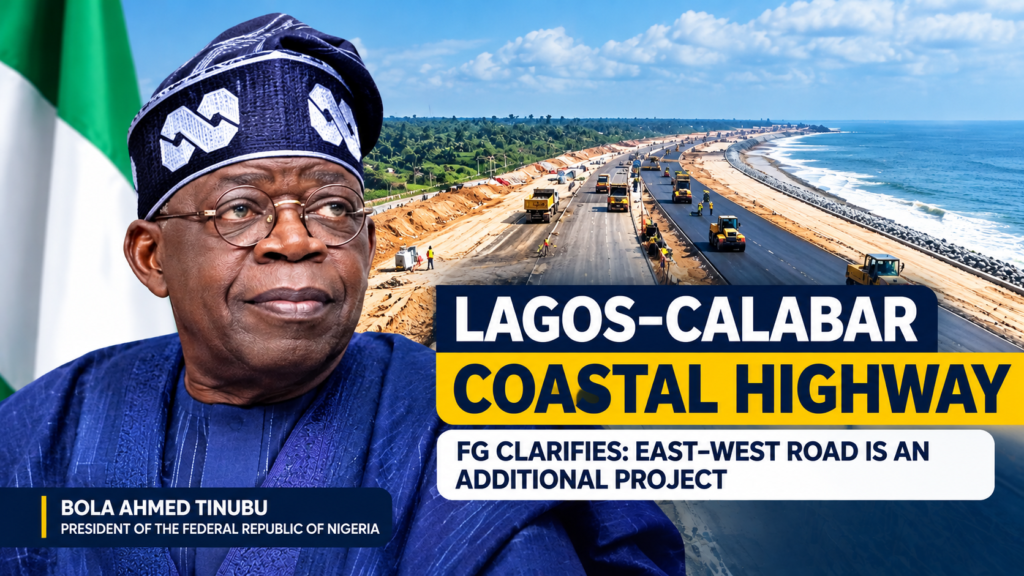
The Federal Government has clarified that the Lagos–Calabar Coastal Highway has not been discontinued or replaced by the East–West Road, explaining that the reconstruction of the existing road is an additional infrastructure project.
The controversy surrounding the Lagos–Calabar Coastal Highway has taken a fresh turn following public concerns over comments suggesting that part of the planned coastal route would be aligned with the existing East–West Road in the Niger Delta.
The clarification from the Federal Ministry of Works addresses the central misunderstanding: the reconstruction of the East–West Road between Edo State and Cross River State is not intended to replace or cancel the proposed 750-kilometre dualised Lagos–Calabar Coastal Highway.
According to the Minister of Works, David Umahi, President Bola Tinubu did not direct that the coastal highway be discontinued in favour of the East–West Road. Rather, the government intends to pursue both projects, with the additional road reconstruction addressing infrastructure challenges in the Niger Delta.
This distinction is essential to understanding the government’s position and the ongoing debate surrounding one of Nigeria’s most prominent infrastructure projects.
WHAT EXACTLY DID THE FEDERAL GOVERNMENT CLARIFY?
In a statement attributed to the Director of Highway Bridges and Design at the Federal Ministry of Works, Engineer Musa Saidu, the ministry explained that the 400-kilometre stretch of the East–West Road from Edo State to Cross River State is an additional route to be reconstructed alongside the Lagos–Calabar Coastal Highway.
The clarification further explained that portions of the existing East–West Road have suffered significant pavement damage and are vulnerable to flooding because sections of the road sit below prevailing flood levels.
The reconstruction is intended to address these challenges and improve the road’s long-term functionality.
Crucially, the ministry stated that the additional project would not prevent the completion of the coastal highway along its originally proposed overall alignment.
In other words, the government is presenting the two projects as complementary infrastructure investments, rather than competing alternatives in which one must be abandoned for the other to proceed.
THE LAGOS–CALABAR COASTAL HIGHWAY REMAINS A SEPARATE PROJECT
The Lagos–Calabar Coastal Highway is a major federal infrastructure initiative designed to improve connectivity along Nigeria’s southern coastline, linking Lagos with Cross River State through several coastal states.
The route is intended to pass through Ogun, Ondo, Delta, Bayelsa, Rivers and Akwa Ibom before reaching Cross River.
The ministry’s clarification identifies a total planned dualised length of approximately 750 kilometres.
It also outlines ongoing work across different sections, including Sections 3A and 3B in Cross River and Akwa Ibom, Sections 4A and 4B in Ogun and Ondo, and Section 5 in Akwa Ibom.
According to the clarification, surveying and design work on the remaining sections are ongoing, with the outstanding route expected to extend through the remaining coastal states and connect with the designated section in Akwa Ibom.
The implication is that the government maintains its commitment to the coastal highway while undertaking additional work on existing infrastructure in the Niger Delta.
The ministry also stated that procurement and construction of the remaining sections would proceed as the relevant surveying and design work is completed.
These are important details for the public because discussions about route adjustments, engineering decisions and supplementary road projects can easily become confused with claims that an entire project has been cancelled.
HOW DID THE MISCONCEPTION ARISE?
The controversy followed public comments about aligning parts of the coastal highway with the existing East–West Road in the Niger Delta.
Those remarks prompted questions about whether the government was changing the original plan, abandoning sections of the proposed route or replacing the coastal highway with the reconstruction of an existing road.
On 12 October 2026, Channels Television reported the Minister of Works’ clarification that the 750-kilometre coastal highway remained intact and that the 400-kilometre East–West Road reconstruction was an additional project.
Pulse Nigeria also reported on 13 October that the minister’s earlier remarks had generated public questions about the route and the future of the project.
These reports help explain why the clarification became necessary.
However, there is a difference between asking legitimate questions about a major public project and presenting an unconfirmed interpretation as an established fact.
Where statements about infrastructure are circulated without their full context, the public can arrive at conclusions that do not accurately reflect the government’s stated position.
The appropriate response is to examine the original clarification, compare it with credible reporting and distinguish confirmed information from speculation.
PUBLIC CRITICISM OF THE PROJECT SHOULD ALSO BE PUT IN CONTEXT
While the claim that the coastal highway has been discontinued is inconsistent with the ministry’s clarification, it would be inaccurate to suggest that every criticism of the project is misinformation.
The Lagos–Calabar Coastal Highway has faced public scrutiny over several issues, including its cost, the circumstances surrounding contract awards, property demolitions, compensation for affected businesses and residents, and potential environmental consequences.
BusinessDay reported on concerns about the project’s procurement process, cost and changes to its alignment in August 2025.
In February 2026, Premium Times reported on a scientific assessment that raised concerns about the potential environmental impact of the highway’s proposed route through the Stubbs Creek Forest Reserve.
These are separate issues that deserve examination based on available evidence.
The government’s clarification about the East–West Road does not, by itself, resolve every question concerning procurement, compensation, environmental assessments or the project’s overall economic value.
Likewise, the existence of such controversies does not establish that the coastal highway has been cancelled.
Responsible public discussion requires these issues to be considered individually, rather than combined into a single narrative that may mislead readers.
WHY THE EAST–WEST ROAD RECONSTRUCTION MATTERS
The existing East–West Road is an important transport corridor for communities and economic activities in the Niger Delta.
Where road surfaces are severely damaged or sections are vulnerable to flooding, reconstruction and improvements to road levels can be important for maintaining connectivity.
The ministry’s position is that reconstructing the affected East–West Road will address these infrastructure challenges while the coastal highway continues through its planned development process.
If implemented as described, the two projects would serve related but distinct purposes: one would provide the proposed coastal highway, while the other would improve an existing transport corridor.
For the public, the central issue is therefore not simply whether one road is being chosen over another. It is whether the government can deliver the projects according to their stated objectives, provide transparent information about their costs and timelines, and demonstrate tangible benefits for the communities they are intended to serve.
WHAT NIGERIANS SHOULD KNOW
Four key points emerge from the Federal Ministry of Works’ clarification.
First, the coastal highway has not been declared cancelled. The ministry has expressly stated that the planned 750-kilometre dualised route remains part of the government’s infrastructure programme.
Second, the East–West Road reconstruction is described as an additional project. The proposed 400-kilometre reconstruction from Edo State to Cross River State is intended to address existing road damage and flooding challenges.
Third, the remaining coastal highway sections are still subject to surveying, design and subsequent construction processes. The government’s stated intention to complete the route should not be confused with a claim that every section has already been completed or is at the same stage of development.
Fourth, legitimate accountability questions remain important. Nigerians are entitled to seek information about project expenditure, engineering decisions, environmental protection, compensation and delivery timelines. Such scrutiny should be informed by evidence rather than assumptions.