
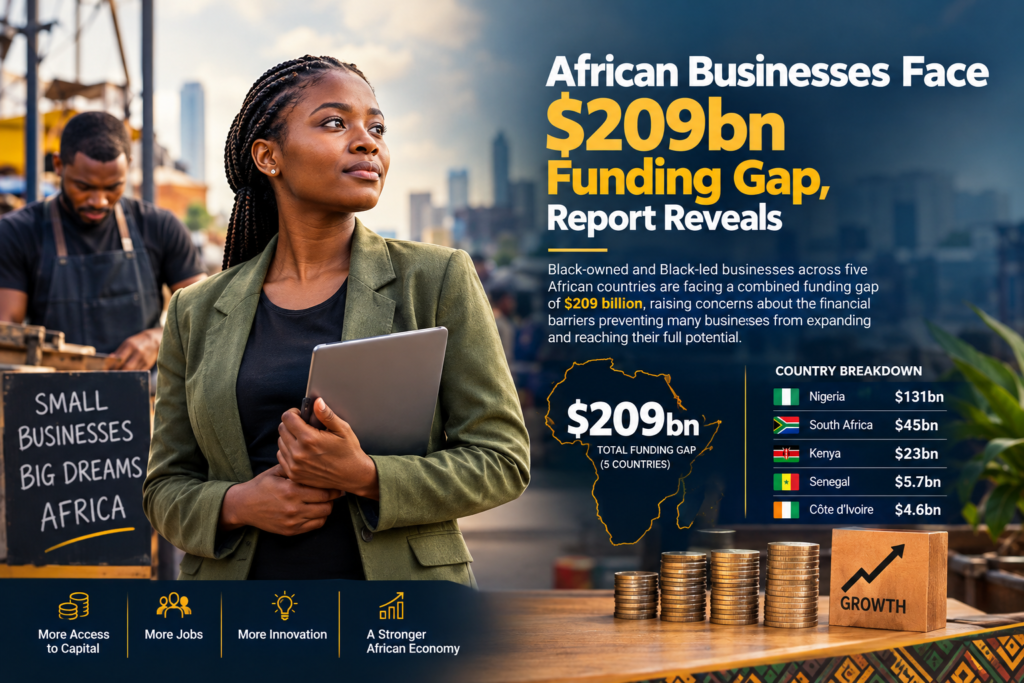
Black-owned and Black-led businesses across five African countries are facing a combined funding gap of $209 billion, raising concerns about the financial barriers preventing many businesses from expanding and reaching their full potential.
The finding comes from a report released by British International Investment (BII), the United Kingdom’s development finance institution and impact investor, in partnership with Swedfund.
Titled Understanding the Investment Gaps in Black-Owned and -Led Businesses in Sub-Saharan Africa, the report examines the challenges these businesses encounter when seeking funding and highlights opportunities for investors to support their growth.
Small Businesses Dominate, but Expansion Remains Difficult
The study covers Nigeria, South Africa, Kenya, Côte d’Ivoire and Senegal. It uses market data and consultations with stakeholders to examine the presence of Black-owned and Black-led businesses, their financing needs and the factors limiting their access to capital.
According to the findings, these businesses account for between 89 and 99 per cent of small businesses across the five countries. However, their representation declines among larger businesses, accounting for 40 per cent in Kenya and 35 per cent in South Africa.
This difference highlights the difficulties many businesses face when trying to grow beyond the small-business stage, where larger amounts of investment are often needed.
The research forms part of BII’s Black Ownership and Leadership for Development (BOLD) initiative, established in 2022 to encourage greater investment in Black-owned and Black-led businesses across sub-Saharan Africa.
Nigeria Records the Largest Funding Gap
The report estimates that Black-owned and Black-led businesses in the five countries face a combined financing gap of $209 billion, approximately four times the gap experienced by businesses outside this category.
Across sub-Saharan Africa, the overall financing gap is estimated at $1.842 trillion.
Nigeria accounts for the largest share of the funding shortfall among the five countries, with an estimated gap of $131 billion. South Africa follows with $45 billion, while Kenya records $23 billion.
Senegal and Côte d’Ivoire have estimated financing gaps of $5.7 billion and $4.6 billion, respectively.
These figures highlight the scale of the challenge facing businesses seeking the capital needed to expand their operations, employ more people and contribute to economic development.
Funding Challenges Differ Across Countries
The report also points out that barriers to financing vary across the countries studied, meaning that a single approach may not address every market’s needs.
In Kenya, stakeholders highlighted difficulties accessing investor networks and early-stage funding. In Nigeria, access to financing in foreign currencies was identified as a more prominent challenge.
The findings suggest that investors and financial institutions may need to adopt country-specific strategies, provide suitable financing options and offer technical support to help businesses overcome these barriers.
Investors Urged to Support Business Growth
Chris Chijiutomi, Managing Director and Head of Africa at British International Investment, said Black-owned and Black-led businesses play an important role in African economies but continue to face significant difficulties accessing capital.
He noted that improving funding opportunities could help reduce inequality while enabling businesses to contribute to economic growth, job creation and innovation.
Chijiutomi added that the research provides a clearer understanding of the obstacles restricting access to finance and offers insights into possible ways to address them.
Similarly, Kitanha Toure, Swedfund’s Regional Director for West Africa, said the findings support the organisation’s commitment to reducing inequality, in line with Sustainable Development Goal 10.
Toure explained that Swedfund’s strategy focuses on increasing investment in low-income markets, improving access to finance for underserved businesses and strengthening local ownership and decision-making.
What the Findings Mean for African Businesses
The report highlights a significant gap between the number of Black-owned and Black-led businesses operating in African markets and the financing available to help them grow.
Closing this gap could create opportunities for business expansion, employment and innovation. However, doing so will require investment approaches that address the different financial and structural challenges businesses face in individual countries.
For Nigeria, where the estimated funding gap stands at $131 billion, improving access to suitable financing could be particularly important for businesses seeking to expand beyond their current size.
The findings underline the need for investors, development finance institutions and other stakeholders to explore practical ways to make capital more accessible to businesses across the continent.
Source: British International Investment and Swedfund report, Understanding the Investment Gaps in Black-Owned and -Led Businesses in Sub-Saharan Africa. Figures and statements are based on the information provided in the original report coverage.