
Africa’s space sector is gaining momentum as countries across the continent increase investment in satellite technology to tackle development challenges and strengthen access to critical data.
Nearly 20 African countries currently have satellites in orbit, with African nations expected to spend more than $800 million on space projects in 2026. The projected spending is almost twice the amount invested in the sector two years earlier.
For governments across the continent, the growing interest in space is increasingly linked to practical needs. Satellite technology is being deployed to monitor weather, conflicts, crops, livestock and infrastructure, providing information that can support planning and decision-making.
In Botswana and Uganda, satellites are being used to monitor mineral resources as well as provide early warnings of droughts and wildfires. Angola is applying satellite communications to connect communities across its expansive interior, while Djibouti uses space-based monitoring to track water levels.
Greater access to satellite information is also helping reduce the need for scientists and other specialists to travel to widely separated monitoring locations to collect data. Such information can assist demographers, agricultural experts, urban planners and meteorologists in identifying flood-prone areas, managing resources and strengthening infrastructure.
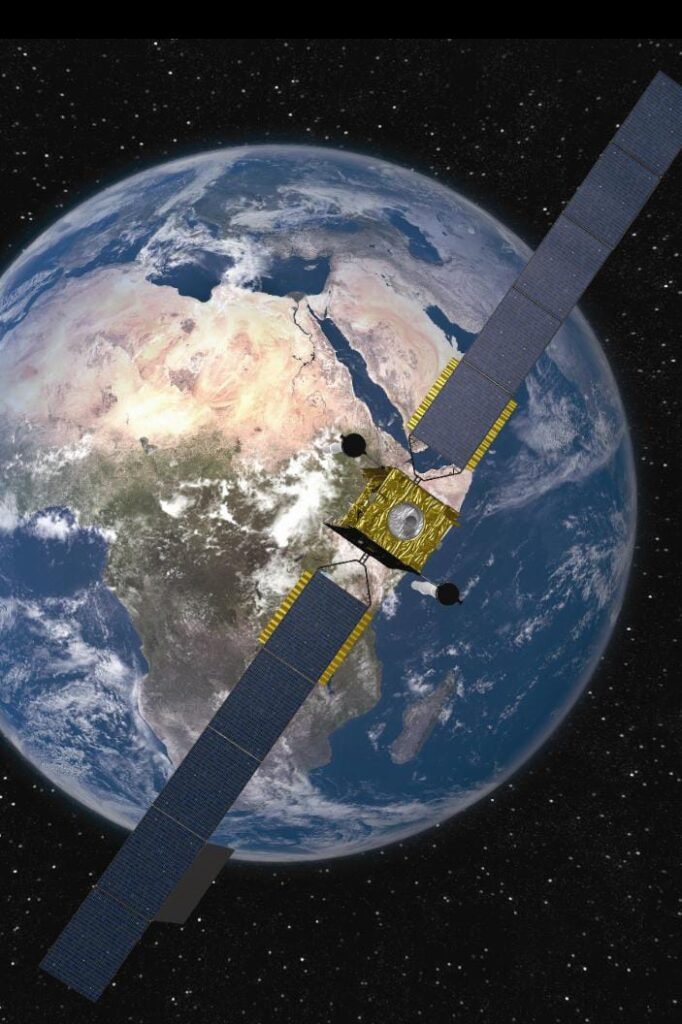
A major step towards continental coordination came in 2025, when the African Union established the African Space Agency to improve cooperation among African countries and facilitate the exchange of expertise and best practices.
Technological advances are meanwhile making participation in the space sector more affordable. The emergence of nanosatellites, which are smaller and less expensive than sophisticated spacecraft, has provided countries with limited resources an opportunity to develop their own space capabilities while building technical expertise.
Senegal is among the countries pursuing an ambitious space programme. After launching its first satellite, GaindeSat-1A, in 2024 to transmit environmental data, the country began developing additional satellites and is considering a constellation of between six and 12 satellites equipped with cameras.
Building the first Senegalese satellite cost approximately $1 million, including the initial equipment required to establish a functional space station. The country expects the cost of subsequent satellites to decrease as its engineers gain more experience in spacecraft design and production.
More than 70 institutions in Senegal could benefit from the proposed satellite constellation, particularly those that currently rely on free but often low-quality imagery. Improved satellite images could, among other applications, help authorities estimate seasonal food production by monitoring farms and livestock.
Another factor opening up the sector is the relatively low cost of nanosatellites. Some can cost as little as $50,000 and weigh less than a bag of flour, providing countries with an affordable means of experimenting with space technology and training engineers.
Senegal’s technical capacity has also continued to develop. Its engineers and technicians initially travelled to the University of Montpellier to build the country’s first satellite with guidance and technology supplied by French engineers. The second satellite is now being developed without hands-on coaching, while the third is expected to be assembled in Senegal and the fourth to depend entirely on locally developed technology.
Interest in Africa’s emerging space capabilities is not limited to countries on the continent. China, Europe, Russia and Japan are among the international powers providing technical training, technological support and other forms of cooperation to African countries developing space programmes.
Africa’s geographical location also gives it strategic importance in global space activities. South Africa is well positioned to support polar-orbiting satellites because of its location in the southern hemisphere, while Djibouti has become an important location for rocket-launch activities.
Space ambitions are also spreading to countries that have not publicly announced plans to launch satellites. Malawi, for example, has established a space programme as part of efforts to develop expertise in the sector.
Despite the progress, Africa still has considerable ground to cover before reaching the capabilities of established space powers. However, increasing investment, expanding technical knowledge and wider use of satellite data are contributing to the development of a growing African space industry.
The expansion is also creating opportunities for African scientists, engineers and institutions to develop expertise within the continent and strengthen Africa’s ability to generate and use space-based data for development, planning and resource management.
NASTV AFRICA
Manifesting Africa’s Greatness