
The incoming Chairman of the Nigerian Economic Summit Group (NESG), Omoboyede Olusanya, has emphasised the need for Nigeria to move beyond recording impressive economic growth figures and focus on improving the welfare of its citizens through better employment opportunities, higher incomes, increased productivity and improved living standards.
He maintained that the true measure of the nation’s economic progress should be the positive changes it brings to the lives of ordinary Nigerians, rather than relying solely on macroeconomic statistics. He further stressed that ongoing economic reforms must produce tangible results, particularly in reducing poverty and creating wider opportunities.
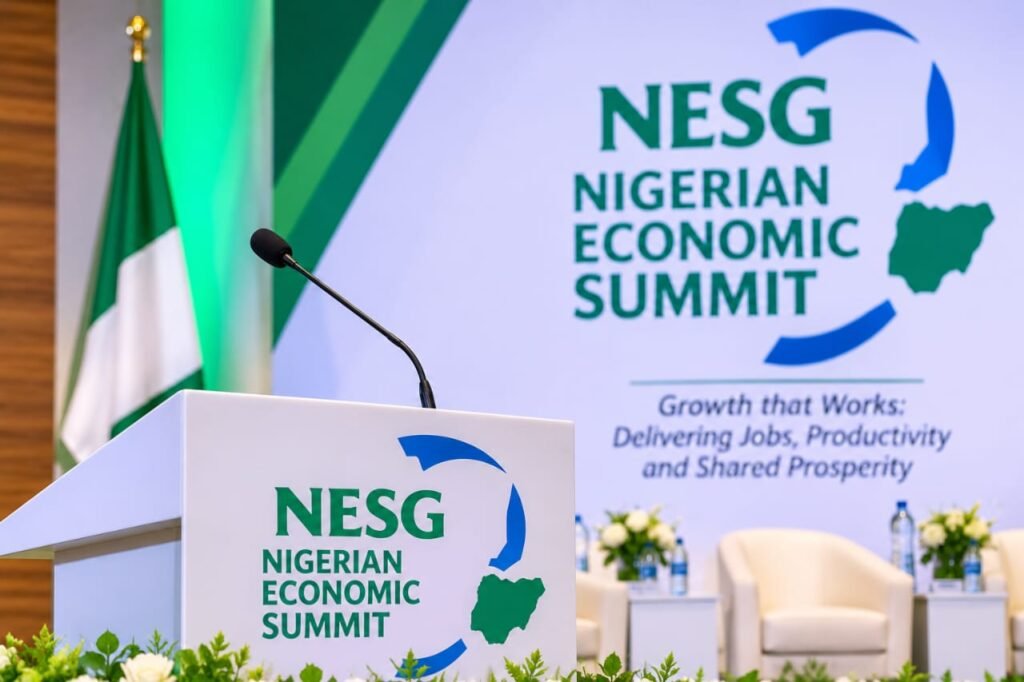
A statement released by the NESG on Sunday disclosed that Olusanya made the remarks at the closing session of the 32nd Nigerian Economic Summit, which took place at the Transcorp Hilton, Abuja, on October 26 and 27, 2026.
Speaking on the need for inclusive economic progress, Olusanya said, “Growth that delivers is growth whose impact is strongly felt.” He explained that meaningful growth should reflect in improved earnings for farmers, lower production expenses for manufacturers, access to decent employment for graduates and affordable financing for businesses.
He further noted that the benefits of economic development should extend to children through better access to nutrition and healthcare.
While recognising that recent government reforms had helped restore macroeconomic stability, the incoming chairman argued that such achievements would have limited value if they did not result in better living conditions for households.
“Bridging the distance between macroeconomic stability and accelerated growth, and between accelerated growth and improved lives and livelihoods, is the task before us all,” he stated.
Introducing “Growth that Delivers” as the central principle of his incoming leadership, Olusanya outlined five major commitments designed to ensure that economic policies produce clear and measurable results.
As part of his plans, he promised to improve accountability by assigning specific implementation officers to key resolutions from the summit, alongside defined timelines and measurable performance targets. He added that the NESG would strengthen its existing accountability structure and release progress reports before the 33rd Nigerian Economic Summit.
He also identified stronger research and policy intelligence as a priority, noting that the group would promote practical, evidence-based recommendations that align with the National Development Plan 2026–2030.
On investment mobilisation, Olusanya pledged to work with government agencies, financial institutions and development partners to transform policy recommendations into projects capable of attracting investment.
Agriculture, manufacturing, infrastructure, technology, entrepreneurship and skills development were listed as key areas that would receive attention in this effort.
Another commitment involves widening access to economic opportunities across the country’s states, with particular attention to micro, small and medium enterprises (MSMEs) and businesses operating in the informal sector through the Scale Nigeria agenda.
His final commitment centres on protecting the institutional independence of the NESG, broadening its membership and encouraging greater involvement of women and young people.
Olusanya also called on governments at all levels to maintain the momentum of economic reforms while addressing major challenges confronting businesses, including high electricity tariffs, logistics costs and other operational difficulties. He emphasised the importance of maintaining consistent economic policies backed by clearly defined implementation targets.
He encouraged private-sector organisations to channel investments into productive ventures, strengthen employees’ skills, ensure fair remuneration and generate sustainable jobs.
Young Nigerians, he said, should equip themselves with relevant skills, pursue entrepreneurship and hold public institutions accountable for their responsibilities. He equally urged civil society organisations to monitor the implementation of government commitments.
Development partners were also advised to ensure that their financial support reflects Nigeria’s development priorities and produces measurable outcomes.
Recognising the contributions of his predecessor, Niyi Yusuf, Olusanya assured stakeholders of his commitment to maintaining the group’s independence and non-partisan identity.
“Our allegiance is to national prosperity and not to any administration,” he said.
He stressed that achieving inclusive economic development would require strong collaboration among government institutions, the private sector, researchers and civil society organisations.
“Growth that works must become growth that delivers. Let us deliver,” Olusanya concluded.
The 32nd Nigerian Economic Summit was held under the theme “Growth that Works: Delivering Jobs, Productivity and Shared Prosperity.” It attracted policymakers, business executives, academics, development partners and civil society representatives to deliberate on Nigeria’s economic priorities.
NASTV AFRICA
Manifesting Africa’s Greatness