
There are moments when a man’s true character is revealed, not by the office he occupies, the wealth he possesses, the title attached to his name or the applause waiting for him, but by what he does when nobody has time to applaud.
On Thursday, September 17, 2026, at Feesu Junction in Iwo, Osun State, one such moment came.
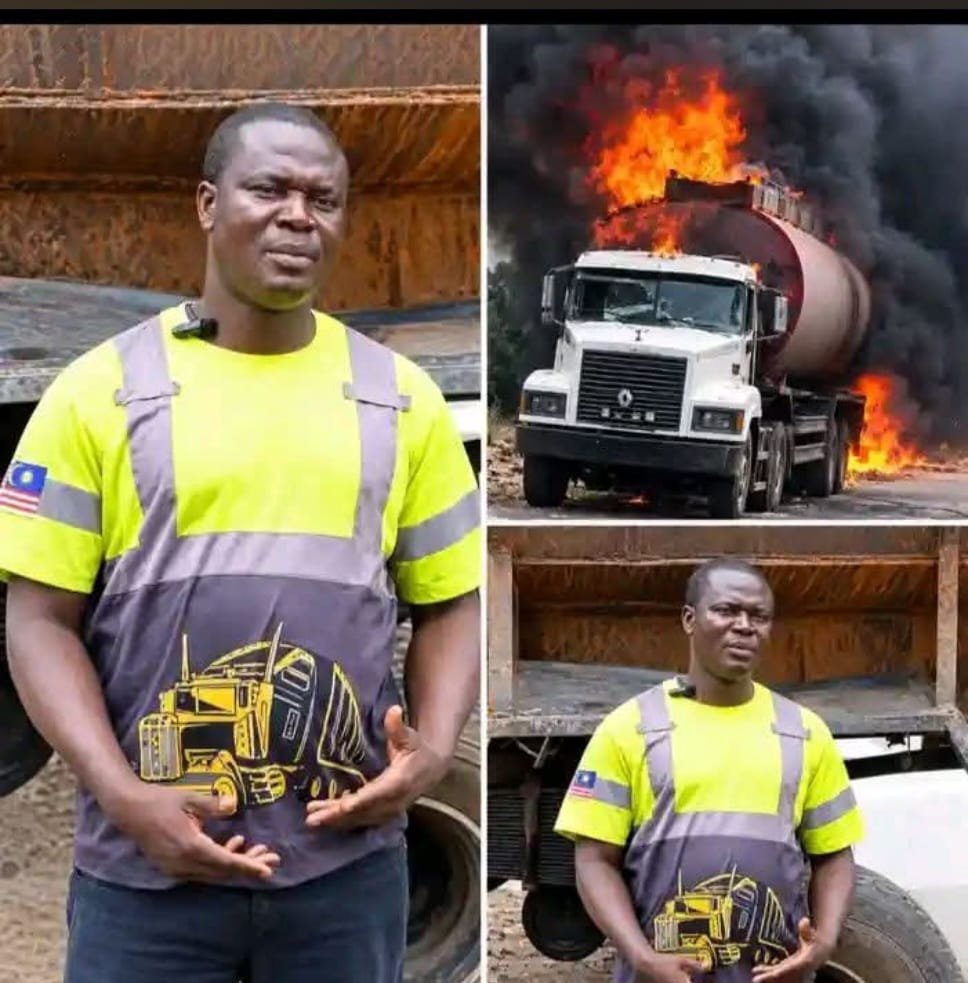
His name is Alagbe Hezekiah, a 38-year-old tanker driver from Ogbomoso.
And for NASTV Africa, this is not merely the story of a tanker driver.
It is the story of a man who, in the most frightening moment of his life, remembered something more important than himself:
other people’s lives.
Reports indicate that Hezekiah was at a filling station along the Iwo-Ibadan Expressway when fire suddenly broke out from the tanker. Attempts to control the flames with a fire extinguisher failed. Around him were filling stations, shops, motorists, homes and unsuspecting members of the public.
The easiest decision would have been to run.
The most natural instinct would have been self-preservation.
But Hezekiah did something different.
He entered the burning vehicle and drove it away from the populated area.
He deliberately moved the danger away from people and toward a less populated riverside location. He eventually separated the truck’s head from the burning tanker, helping to contain the danger.
No reported loss of life followed the incident.
Think about that for a moment.
A man saw danger coming towards hundreds of people and decided to move himself closer to it so that the danger could move farther away from them.
That is the part of this story that should concern Africa.
Because Africa does not merely need more people seeking leadership.
Africa needs more people willing to serve.
THIS IS THE LEADERSHIP WE MUST TEACH.
In my book, Language of Life and Leadership, I explored a simple but profound word:
LEAD-HARDSHIP.
Leadership is not always born from comfort.
Sometimes leadership is born when a person is willing to enter hardship so that others can experience safety, dignity and opportunity.
Hezekiah did not have a political office.
He did not have a convoy.
He did not have an official title.
He did not wait for somebody to declare him a leader.
A crisis arrived, and responsibility found him.
And he answered.
That is leadership.
There is another word in the book:
SERVE-ANT.
A servant is one who is willing to serve even the “ants” of society, the ordinary people whose names may never appear in newspapers, whose photographs may never hang on government walls and whose contributions may never receive public recognition.
Hezekiah’s passengers were not sitting in a luxury vehicle.
They were ordinary Nigerians going about their daily lives.
Yet their lives mattered to him.
That is the essence of servant leadership.
FROM OGBOMOSO TO IWO, A LESSON FOR AFRICA
History remembers people who placed humanity above themselves.
From Nelson Mandela, whose leadership became associated with reconciliation after years of imprisonment, to Mahatma Gandhi, whose philosophy placed service and sacrifice at the centre of public life, to countless unnamed community leaders, rescuers, teachers, health workers and ordinary citizens who have stepped forward when others stepped back, one lesson remains constant:
Leadership becomes meaningful when somebody else becomes better, safer or freer because you were there.
Hezekiah belongs to that larger human tradition of responsibility.
Not because we should romanticise danger.
Not because people should recklessly sacrifice their lives.
And certainly not because society should expect individuals to substitute personal bravery for functioning emergency systems.
Rather, because in an extraordinary emergency, he made a decision that placed the safety of other people at the centre of his thinking.
That distinction matters.
Heroism is not the reckless pursuit of death.
Heroism is accepting responsibility when responsibility is urgently required.
IMAGINE WHAT COULD HAVE HAPPENED
Imagine the location.
A burning tanker.
Fuel infrastructure nearby.
Businesses.
Homes.
Motorists.
Pedestrians.
A busy road.
A fire spreading rapidly.
Now imagine the driver simply abandoning the vehicle.
The consequences could have been devastating.
Eyewitness accounts reported that his action helped prevent the fire from spreading to nearby facilities and populated areas.
We may never know the exact number of people who might have been affected had the tanker remained where the fire started.
And perhaps that is one of the most profound things about heroism.
The greatest lives a hero saves are sometimes the lives we never get to count.
There are children who went home that evening.
Parents who embraced their children.
Traders who closed their shops.
Drivers who continued their journeys.
Families who slept peacefully.
Perhaps they will never know the name Alagbe Hezekiah.
But their ordinary evening may have continued because one man refused to think only about himself.
THE AFRICA WE MUST BUILD
This is the kind of story we must teach our children.
Not only stories of presidents.
Not only stories of billionaires.
Not only stories of generals.
Not only stories of celebrities.
Let us teach them about the tanker driver.
The teacher.
The nurse.
The farmer.
The mechanic.
The security officer.
The civil servant.
The entrepreneur.
The neighbour.
The ordinary citizen who chooses to do the right thing when doing so comes at a personal cost.
Because leadership is not a title.
Leadership is a decision.
A decision to take responsibility.
A decision to protect.
A decision to serve.
A decision to put people before personal convenience.
And sometimes, a decision to say:
“If someone must carry this burden, let me carry it.”
HEZEKIAH, YOUR STORY MUST NOT END WITH THE FIRE
Alagbe Hezekiah has spent more than two decades driving tankers, having entered the profession in 2004.
Yet he reportedly said he had never encountered an emergency like this before.
His story therefore deserves more than social-media applause.
It deserves reflection.
It deserves recognition.
It deserves to be documented.
And above all, it deserves to become a lesson.
Let his story remind every Nigerian that greatness does not always arrive wearing a suit.
Sometimes greatness wears a driver’s uniform.
Sometimes courage sits behind the steering wheel.
Sometimes a hero comes from Ogbomoso, drives through Iwo and leaves behind a lesson for an entire continent.
Africa, remember this name: ALAGBE HEZEKIAH.
Not because he sought fame.
Not because he sought a title.
But because, at a moment when he could have thought only about himself, he thought about the people.
And that is where leadership begins.
NASTV AFRICA MAN OF THE WEEK
ALAGBE HEZEKIAH
Ogbomoso-born.
Nigeria’s courageous tanker driver. A reminder that the true measure of leadership is not how many people stand behind you, but how many people are safer because you stood up.
NASTV AFRICA
Manifesting Africa’s Greatness.
We tell our stories ourselves.
By Nasir Abdulquadri
Founder ,Nastv Africa