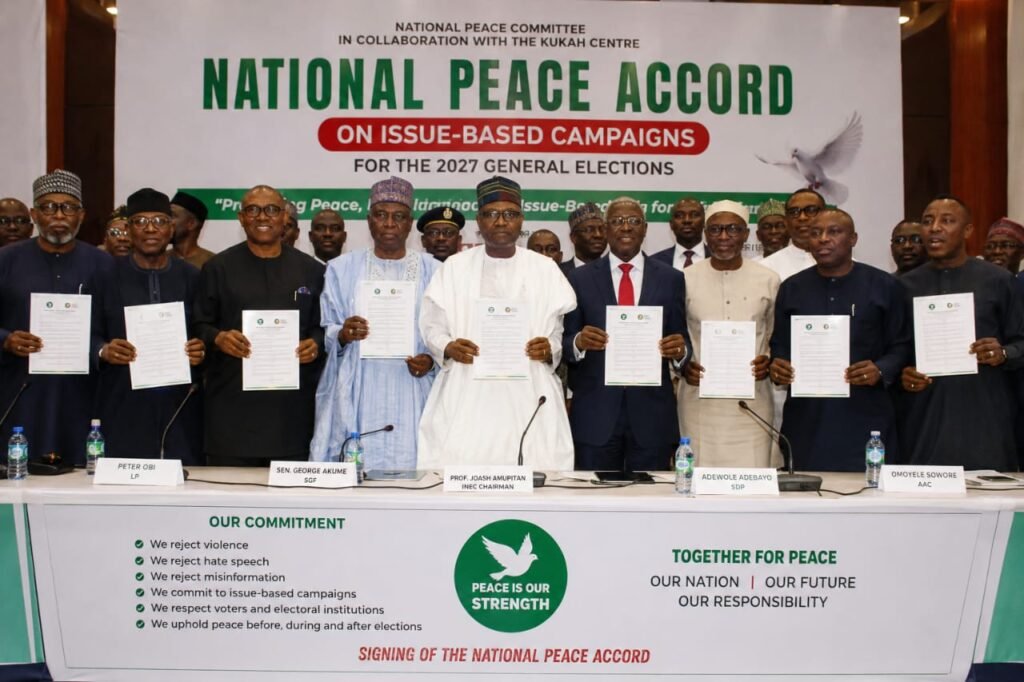
Political parties and candidates contesting the 2027 presidential and National Assembly elections have signed the first National Peace Accord on issue-based campaigns, committing themselves to peaceful conduct as political activities officially commence.
The agreement was signed in Abuja on Tuesday at a ceremony organised by the National Peace Committee in collaboration with The Kukah Centre, a day before the statutory commencement of public campaigns and rallies for the 2027 elections.
The accord requires political parties and candidates to reject violence, hate speech, misinformation, personal attacks and other actions capable of threatening the credibility and peaceful conduct of the electoral process.
The event was attended by the Chairman of the Independent National Electoral Commission, Prof Joash Amupitan; political party leaders; presidential and National Assembly candidates; the Inspector-General of Police, Olatunji Disu; members of the diplomatic community and other stakeholders.
Among those who signed the agreement were President Bola Tinubu, who was represented by the Secretary to the Government of the Federation, Senator George Akume; Nigeria Democratic Congress presidential candidate Peter Obi; Social Democratic Party candidate Adewole Adebayo; and African Action Congress candidate Omoyele Sowore.
Also present were the National Chairman of the All Progressives Congress, Prof Nentawe Yilwatda; Peoples Redemption Party presidential candidate Donald Duke; Labour Party presidential candidate Chibuzor Okereke; Deputy President of the Senate, Barau Jibrin; PRP National Chairman, Hakeem Baba-Ahmed; lawmakers, political party leaders and other candidates.
Goodwill messages were also delivered by members of the diplomatic community, including the European Union Ambassador to Nigeria, Gautier Mignot, and the Swiss Ambassador to Nigeria, Patrick Egloff.
However, former Vice-President Atiku Abubakar and Oyo State Governor Seyi Makinde were not present at the ceremony. Atiku is the presidential candidate of the African Democratic Congress, while Makinde is contesting under the Allied Peoples’ Movement.
The Chairman of the National Peace Committee and former Head of State, General Abdulsalami Abubakar (retd.), was represented at the event by former Chief of Defence Staff, General Martin Agwai (retd.).
The signing came amid heightened political activities ahead of the 2027 elections, with issues such as the economy, insecurity, unemployment, poverty, infrastructure and the credibility of the electoral system expected to feature prominently in the campaigns.
Under INEC’s revised timetable, the presidential and National Assembly elections are scheduled for January 16, 2027, while the governorship and State House of Assembly elections will take place on February 6, 2027.
Speaking through Akume, President Tinubu called on political parties and candidates to put Nigeria’s interests ahead of personal and partisan ambitions, stressing that the pursuit of political power should never turn into a battle in which all means are considered acceptable.
He also warned politicians against using ethnic and religious sentiments to influence voters, urging candidates to focus their campaigns on policies, programmes and ideas capable of addressing the country’s challenges.
Tinubu described the signing as a commitment by political leaders to Nigerians that their political ambitions would not be placed above national interest.
According to the President, political contests will naturally produce disagreements and strong exchanges, but such differences must not be allowed to undermine national unity.
He urged candidates to compete through ideas and policy alternatives, rather than resorting to ethnic or religious divisions.
Tinubu further stated that the All Progressives Congress was committed to the terms of the agreement and would oppose violence, hate speech, misinformation, incitement and digital manipulation, including the misuse of artificial intelligence and social media.
He called on other political parties and political actors to make similar commitments to peaceful, transparent and credible elections.
The President also commended the National Peace Committee for its continued involvement in Nigeria’s electoral process since 2014, noting that the committee had provided a platform for political actors to publicly commit themselves to peaceful elections.
He said improvements had also been recorded in election management, particularly through the adoption of technology by INEC, citing the Permanent Voter Cards, the Bimodal Voter Accreditation System and electronic accreditation as measures that had strengthened confidence in the electoral process.
Tinubu also pointed to recent off-cycle governorship elections in Anambra, Ekiti and Osun States as examples of developments in electoral administration and voter participation.
The INEC Chairman, Prof Joash Amupitan, described the peace accord as more than a ceremonial exercise, saying it provided an opportunity for political actors to establish the standards that should guide the 2027 contest before campaigns officially began.
Amupitan noted that Wednesday, August 19, 2026, marked the statutory commencement of public campaigns and rallies for the 2027 general elections.
He said it was important for those seeking political office to first agree on the ethical limits of the competition before campaigns, rallies and political messaging intensified across the country.
According to the INEC chairman, Nigerians expect candidates to use the campaign period to address the problems confronting the country rather than engage in personal attacks, insults and inflammatory rhetoric.
He disclosed that information from the National Peace Committee’s Election Security Information Hub had revealed an alarming increase in hate speech, toxic political polarisation, coordinated misinformation and personality-centred political discussions.
Amupitan said the development was particularly concerning as the country approached what was expected to be one of the most competitive elections since Nigeria returned to democratic rule in 1999.
He urged candidates to make the economy, national security, infrastructure, healthcare, education and social inclusion major issues in their campaigns.
The INEC chairman described elections in a democracy as a competition for public service rather than warfare, stressing that Nigerians were looking for solutions to their challenges rather than political insults.
He also warned parties and their supporters against announcing premature victories and circulating unverified information on social media.
According to him, the increasing use of artificial intelligence and digital platforms has introduced new challenges to election management, particularly through disinformation and foreign information manipulation and interference.
Amupitan urged presidential candidates, party leaders and campaign organisations to ensure that their supporters and online teams respected the provisions and spirit of the peace accord.
He stressed that achieving political power at the cost of public peace, institutional credibility or human lives would amount to an empty victory.
The INEC chairman also assured all political parties that the commission had no preferred candidate and would provide an equal platform for all contestants.
He disclosed that INEC was preparing to deploy about 1.4 million ad hoc personnel for the 2027 elections across more than 176,000 polling units nationwide.
Amupitan said the commission was using lessons from recent off-cycle elections, including the governorship polls in Anambra, Ekiti and Osun States and the Federal Capital Territory Area Council election, to strengthen its preparations for the 2027 polls.
He, however, emphasised that technological and administrative preparations alone could not guarantee peaceful elections, noting that the conduct of candidates, political parties and their supporters would remain a major factor.
He urged political actors to recognise that the credibility of the 2027 election would depend not only on INEC but also on candidates’ willingness to respect democratic rules and the institutions responsible for conducting the polls.
Representing the National Peace Committee, General Agwai disclosed that the committee had facilitated 30 peace accords since 2015, consisting of five national-level agreements and 25 subnational accords.
He added that faith-based peace structures had also been established in 23 states to strengthen the committee’s peace-building efforts.
He explained that the issue-based peace accord was developed in response to the growing practice of political campaigns centred on sentiments, personal attacks and character assassination rather than manifestoes, policies and programmes.
The accord seeks to encourage candidates and parties to compete based on ideas, engage in respectful debates, organise their supporters peacefully, protect voters, respect electoral institutions and reject hate speech and misinformation.
Agwai expressed concern over the declining standard of political discourse, noting that campaigns and rallies had increasingly moved away from party manifestoes and programmes towards name-calling, personal insults and character assassination.
He said the provisions of the agreement were based on the Constitution, the Electoral Act and other relevant laws, making the accord more than a mere political statement.
He also revealed that the National Peace Committee had created the Election Security Information Hub to monitor electoral offences and security developments while providing early warnings and evidence-based analysis to relevant stakeholders.
Peter Obi, while speaking at the event, said political leaders should not require a peace accord before conducting themselves responsibly, arguing that anyone seeking public office should demonstrate exemplary behaviour before being elected.
Obi said his participation was motivated by his desire to change the political system from within.
He also maintained that the personal conduct of political candidates should reflect the responsibilities of the offices they seek, urging contestants to ensure their behaviour remained consistent with the standards expected of public officials.
The Labour Party candidate called on political actors to make their campaigns responsive to the issues affecting Nigerians and to ensure that their conduct reflected the seriousness of the offices they were seeking.
He also called for remembrance and accountability following deaths recorded during the recent Osun governorship election, urging political actors to sympathise with the families of those who lost their lives.
Obi said no Nigerian should have to lose his or her life because of an election and expressed hope that such incidents would not occur again.
When asked about his major concern ahead of the 2027 election, Obi identified the integrity of the voting process, asking that Nigerians be allowed to participate in an election where their votes would genuinely count.
On possible punishment for candidates or parties that violate the peace agreement, he said voters should be responsible for imposing the ultimate sanction by refusing to vote for such candidates.
Meanwhile, the AAC presidential candidate, Omoyele Sowore, expressed doubts about the effectiveness of the peace accord, describing it as a ritual that had not prevented electoral violence in the past.
Sowore said his presence at the ceremony should not be interpreted as an indication that he believed the agreement would automatically prevent violence.
He questioned the description of the recent Osun governorship election as peaceful, alleging that about 50 people had died in connection with the election.
The AAC candidate also criticised INEC over the electronic transmission and uploading of results from the Osun election, alleging that the commission had not completed the upload of all results three days after the election.
He argued that a peace agreement without enforceable sanctions would have limited impact, noting that political actors who sign such agreements should be held accountable if they subsequently engage in violence.
Sowore called instead for what he described as a justice accord, which he said should provide clear and enforceable consequences for candidates and political actors who breach the agreement.
He also questioned why the deaths allegedly linked to the Osun election had not generated stronger political accountability.
Despite his criticism of the process, Sowore commended voters in Osun for participating in the election despite the reported violence, describing the estimated 40 per cent turnout as an indication of civic consciousness.
On the part of the Nigeria Police Force, the Inspector-General of Police, Olatunji Disu, represented by the Deputy Inspector-General of Police in charge of Operations, Umar Shehu, pledged that the police would provide security for voters, candidates and other stakeholders throughout the electoral process.
Shehu said the police were not concerned about which candidate or party emerged victorious, but were focused on ensuring that eligible Nigerians could exercise their franchise without fear or intimidation.
The police leadership also appealed to political parties and their supporters to cooperate with security agencies and refrain from actions capable of triggering violence before, during and after the elections.
The Chairman of the Inter-Party Advisory Council, Yusuf Dantalle, similarly called on political parties, candidates, campaign councils and spokespersons to uphold the provisions of the peace accord.
Dantalle urged political actors to avoid fake news, personal attacks and insults, while promoting tolerance, civility and constructive political engagement as the 2027 campaign season begins.
NASTV AFRICA
Manifesting Africa’s Greatness